Shopify vs Custom eCommerce Development: How to Choose the Right Platform
Shopify, headless Hydrogen or a fully custom composable build? Compare cost of ownership, time to market, B2B needs, integrations, performance and lock-in, then use our checklist to decide.
⚡ Key takeaways
- Standard Shopify or Shopify Plus is the fastest, lowest-risk route for most D2C brands with conventional catalogs and checkout flows.
- Headless Shopify with Hydrogen keeps Shopify as the commerce engine while giving you full control of the frontend, performance and UX.
- Fully custom or composable builds pay off when pricing, B2B workflows or your business model genuinely do not fit a SaaS platform.
- Decide on total cost of ownership, integration depth (ERP, PIM, OMS) and lock-in, not on build cost or feature checklists alone.
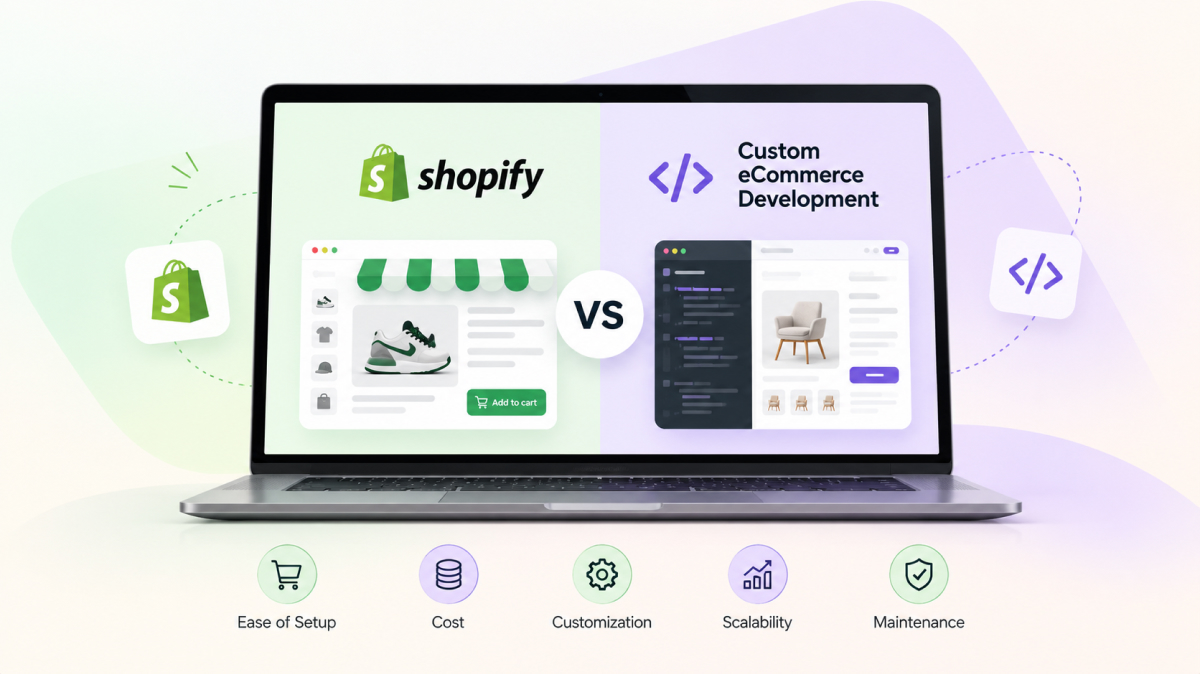
The Shopify vs custom ecommerce decision is rarely a simple either/or. In practice you are choosing between three architectures: Shopify (including Shopify Plus) with a theme, headless Shopify where a custom Hydrogen storefront sits on top of Shopify’s commerce engine, and a fully custom or composable stack assembled from best-of-breed services.
Each option shifts cost, speed and control in different directions. This guide compares them across total cost of ownership, time to market, flexibility, B2B requirements, integrations, performance, scalability and lock-in, and ends with a practical checklist you can use in your next platform review.
The three options, defined
Before comparing, it helps to be precise about what each option means, because “custom” and “headless” are used loosely in vendor conversations.
Shopify and Shopify Plus (theme-based)
Shopify hosts everything: catalog, cart, checkout, payments, admin and the storefront, which is rendered from a Liquid theme. Shopify Plus adds enterprise features such as checkout customization through Checkout Extensibility, B2B tooling, automation and higher API limits. You extend the store with apps and theme code rather than owning the servers.
Headless Shopify (Hydrogen)
Shopify remains the system of record for products, inventory, orders and checkout, but the storefront is a separate application. Hydrogen is Shopify’s React-based framework for this, built on Remix and now React Router, and it reads data through the GraphQL Storefront API. You can host it on Shopify’s Oxygen or your own infrastructure. The official Shopify headless documentation covers the building blocks.
Fully custom or composable commerce
Here you own the commerce backend, or you assemble it from specialist services: a commerce engine, a search service such as Algolia, a headless CMS, a PIM, an OMS and a payment provider such as Stripe Connect for marketplaces. A custom frontend ties it together. You get maximum control and take on maximum engineering responsibility.
Shopify vs custom ecommerce: side-by-side comparison
The table below summarizes how the three approaches typically behave. Treat it as a starting point: the right answer depends on your catalog, channels and team.
| Factor | Shopify / Shopify Plus | Headless Shopify (Hydrogen) | Custom / composable |
|---|---|---|---|
| Upfront build cost | Lowest | Medium to high | Highest |
| Ongoing cost | Subscription, apps, payment fees | Subscription plus frontend team and hosting | Engineering team, hosting, licenses for each service |
| Time to market | Fastest | Moderate | Slowest |
| Frontend and UX freedom | Limited by theme architecture | Full | Full |
| Checkout control | Configurable within Shopify rules | Shopify checkout, extensible on Plus | Complete |
| B2B pricing and workflows | Good on Plus for standard B2B | Good on Plus, custom UX possible | Anything you can specify |
| ERP, PIM, OMS integration | Apps and middleware | Apps, middleware or custom services | Designed in from day one |
| Performance ceiling | Good, theme and app dependent | Very high | Very high, if engineered well |
| Operational burden | Low | Medium | High |
| Lock-in risk | Platform | Commerce engine only | Vendors you choose, or your own code |
Total cost of ownership and time to market
In any Shopify vs custom ecommerce evaluation, build cost is the number everyone asks about first, but it is the least useful number on its own. Total cost of ownership over three to five years includes subscriptions, app fees, payment processing, hosting, engineering time for new features, and the cost of workarounds when the platform does not do what you need.
A theme-based Shopify store has the lowest upfront cost and the quickest launch because checkout, hosting, security and PCI scope are handled for you. The trade-off is recurring app spend and the hidden cost of bending the business to fit the platform. Headless adds a frontend codebase that someone must maintain, deploy and monitor. Custom and composable builds carry the highest ongoing engineering cost, but remove platform fees and constraints that become expensive at scale.
As an indicative guide only, a theme-based launch is often measured in weeks, a headless storefront in a few months, and a composable platform in several months or more. Actual timelines depend heavily on scope, integrations and data migration.
Flexibility and B2B requirements
Flexibility matters most where your business differs from a standard retail flow. For D2C brands with a conventional catalog, Shopify’s model fits well and its constraints are rarely felt. Friction appears with complex bundling, configurable products, subscriptions with unusual rules, or multi-vendor marketplaces with seller onboarding and split payments.
B2B is where the gap is widest. Shopify Plus supports company accounts, customer-specific catalogs and price lists, and payment terms, which covers many wholesale use cases. Manufacturers and distributors often need more:
- Account hierarchies with buyers, approvers and budget limits per location.
- Purchase order workflows and multi-step approval chains.
- Contract pricing, tiered volume discounts and CPQ for configured quotes.
- Real-time pricing and availability pulled from an ERP such as SAP or Odoo.
- Reordering, quick order by SKU and punchout to procurement systems.
If your list stops at the first three items, Shopify Plus, possibly with a headless frontend for a tailored buying experience, is usually sufficient. If ERP-driven pricing and approval logic sit at the heart of the process, a custom B2B commerce platform is often the cleaner long-term answer.
Integrations: ERP, PIM and OMS
Integrations are where eCommerce projects succeed or stall. The storefront is only one part of the system; the ERP holds financials and stock, a PIM holds rich product data, and an OMS routes orders across warehouses, stores and marketplaces.
On Shopify, integrations run through the Admin API, webhooks and apps, often with middleware to handle mapping, retries and rate limits. This works well when Shopify can be the source of truth for products and orders. It becomes harder when the ERP must own pricing and inventory in real time, when you sell across web, POS and marketplaces from one stock pool, or when order routing logic is complex.
A composable architecture lets you design these data flows deliberately: which system owns each entity, how events propagate, and how conflicts are resolved. Headless Shopify sits in between, since you can add custom backend services alongside Shopify without replacing it.
Not sure which commerce architecture fits?
OMANGOM is a Shopify Partner that also builds headless and composable platforms. We will map your catalog, integrations and growth plans, then recommend a stack.
Performance and scalability
Shopify’s infrastructure handles traffic spikes well, which removes one of the biggest operational risks for growing brands. Storefront speed is a different question. Theme-based stores slow down as apps inject scripts and themes accumulate customizations, which hurts Core Web Vitals and conversion, especially on mobile.
A headless Hydrogen storefront gives your team direct control over rendering, caching, code splitting and third-party scripts. That raises the performance ceiling, but only if the team treats performance as a requirement. Our guide on how to improve Core Web Vitals explains the techniques that matter most.
Fully custom platforms can scale to any load, provided you invest in autoscaling, CDN caching, a resilient checkout and realistic load testing before peak events. Scalability here is an engineering outcome, not a platform feature.
Headless and custom builds raise the performance ceiling. Whether you reach it depends on engineering discipline, not on the architecture diagram.
Lock-in, ownership and risk
Every option has lock-in; the question is where it sits. With theme-based Shopify you depend on the platform’s roadmap, pricing and rules, and your theme code is not portable. With headless Shopify your frontend is yours and portable, while the commerce engine remains Shopify. Replatforming later means swapping the backend, not rebuilding everything.
With custom or composable builds you own more, but you are tied to your own code quality, your team’s knowledge and the vendors you selected. Good documentation, clean APIs and clear ownership of each domain reduce that risk. Poorly structured custom builds can become harder to escape than any SaaS platform.
Decision checklist: Shopify vs custom ecommerce
Use this checklist to shortlist an approach, then validate it against your integrations and total cost model.
Choose Shopify or Shopify Plus if…
- Your catalog, pricing and checkout follow standard retail patterns.
- Speed to market and low operational overhead matter more than UX differentiation.
- Your B2B needs are covered by company accounts, price lists and payment terms.
- You do not have, or want, a dedicated frontend engineering team.
Choose headless Shopify (Hydrogen) if…
- You are a D2C brand outgrowing themes and need full creative control and better performance.
- You want Shopify’s checkout, admin and app ecosystem, but a custom storefront.
- You need to combine content, commerce and personalization in one experience.
- You can fund a team to own and evolve the frontend after launch.
Choose custom or composable commerce if…
- Your business model, such as a multi-vendor marketplace, does not fit a SaaS platform.
- ERP-driven pricing, approval chains or CPQ are central to how customers buy.
- You need one inventory and order view across web, app, POS and marketplaces with complex routing.
- Platform fees and constraints cost more than owning the stack, and you have engineering capacity to run it.
Whichever you choose, plan for post-launch optimization. Our guide to eCommerce conversion rate optimization covers the engineering fixes that lift sales once the platform is live, and our retail and eCommerce work spans storefronts, OMS, inventory and POS.
Frequently asked questions
Is Shopify better than custom ecommerce development?
Neither is better in general. Shopify is better when your requirements fit its model, because you launch faster with less risk. Custom development is better when your pricing, workflows or business model do not fit, and working around the platform would cost more than owning the stack.
What is headless Shopify?
Headless Shopify separates the storefront from Shopify’s backend. Shopify still manages products, inventory, orders and checkout, while a custom frontend, often built with Hydrogen, renders the shopping experience using the Storefront API.
When should you move off Shopify themes?
Consider moving when theme limitations block key UX changes, app scripts drag down page speed, or you need to merge content and commerce in ways Liquid makes awkward. Going headless on Shopify is usually a smaller step than a full replatform.
Can Shopify handle B2B ecommerce?
Shopify Plus includes B2B features such as company accounts, catalogs, price lists and payment terms, which suit many wholesale models. Complex approval chains, CPQ or real-time ERP pricing often need custom services or a purpose-built B2B platform.
How long does it take to build a custom ecommerce platform?
It depends on scope, integrations and data migration. As an indicative range, a focused first release covering storefront and checkout can take a few months, with further phases for B2B, marketplace or omnichannel features.
Next steps
The right answer to Shopify vs custom ecommerce comes from your catalog, buyers, integrations and growth plans, not from a generic feature list. OMANGOM is a Shopify Partner that builds theme-based, headless Hydrogen and fully composable commerce, so we can recommend the stack that fits rather than the one we prefer. Explore our Digital Commerce services or get in touch to discuss your platform.