RAG vs Fine-Tuning: Which AI Approach Is Right for Your Business?
A practical way to choose between retrieval-augmented generation and fine-tuning: separate knowledge gaps from behavior gaps, compare costs and risks, and see which approach fits common business scenarios.
⚡ Key takeaways
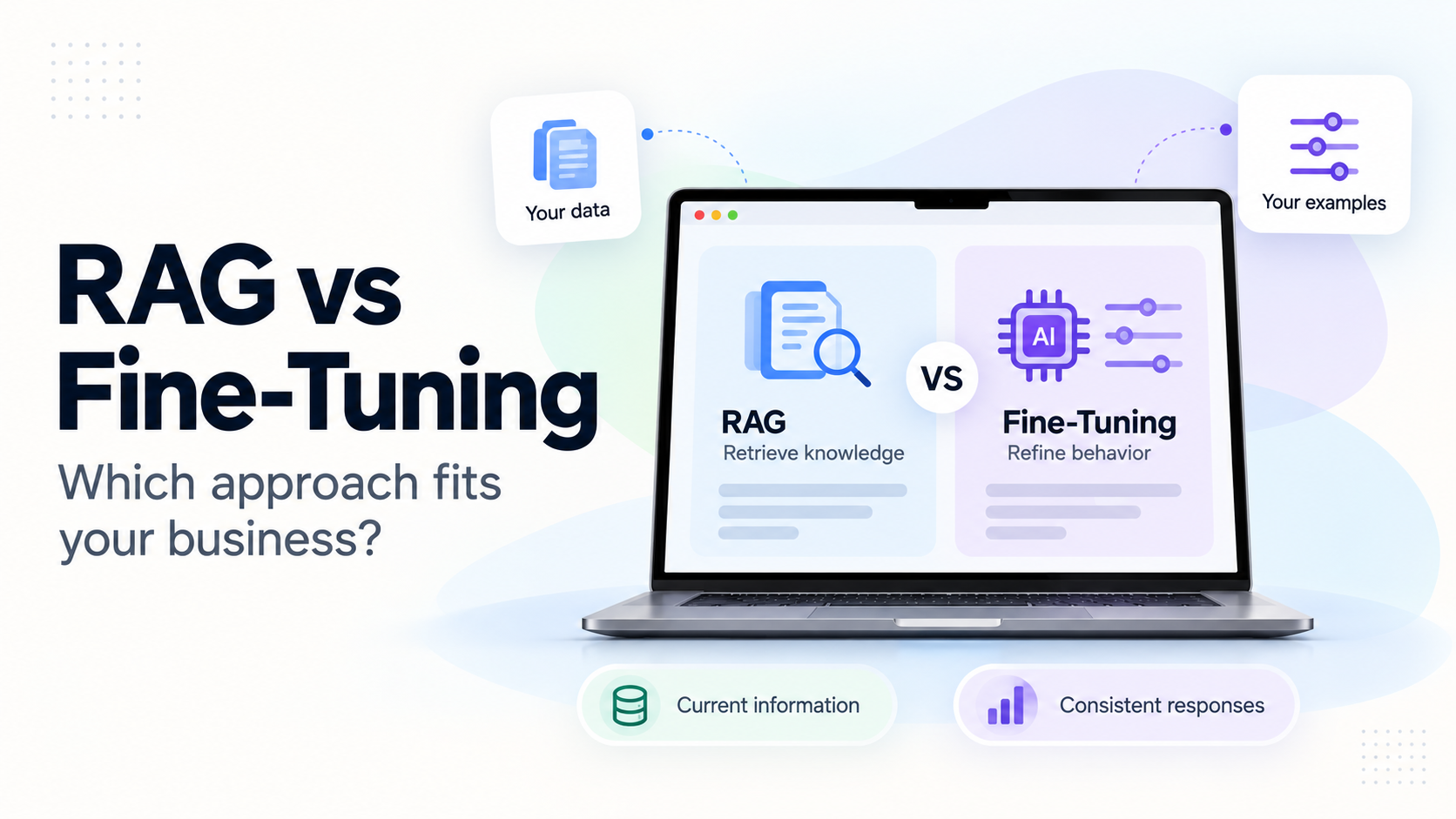
- Use RAG when the model needs to know things: your documents, products, policies or data that changes.
- Use fine-tuning when the model needs to behave differently: a consistent format, tone, classification scheme or specialist task.
- Start with good prompts and retrieval; fine-tune only when evaluation shows a gap that prompting and RAG cannot close.
- Many production systems combine both: retrieval supplies the facts, a tuned model handles the style and structure.
The RAG vs fine-tuning debate usually starts with the wrong question. Teams ask which technique is more powerful, when the useful question is what problem they are trying to fix. Retrieval-augmented generation (RAG) and fine-tuning both customize a large language model for your business, but they change different things, cost different amounts to maintain and fail in different ways.
This article gives you a practical way to choose. We separate knowledge problems from behavior problems, compare the two approaches on the criteria that matter in production, walk through common business scenarios and explain when combining them is worth the extra complexity.
Start here: a knowledge problem or a behavior problem?
Before comparing techniques, look at why the base model’s answers fall short today. Almost every gap falls into one of two buckets.
- Knowledge gap. The model does not know your pricing, your product catalog, last week’s policy update or the contents of a customer contract. It either guesses or says it cannot help.
- Behavior gap. The model knows enough, but it does not respond the way you need. It ignores your output format, drifts from your brand voice, misclassifies domain-specific inputs or is too slow and expensive for a narrow, high-volume task.
RAG fixes knowledge gaps by handing the model the right information at query time. Fine-tuning fixes behavior gaps by adjusting the model’s weights with examples of the responses you want. Using fine-tuning to teach facts, or RAG to enforce a strict format, is where most projects go wrong.
Retrieval changes what the model can see. Fine-tuning changes how the model responds. Pick the one that matches the gap you actually have.
How RAG works
RAG keeps the model unchanged and adds a retrieval step in front of it. Your documents are split into chunks, converted into embeddings and stored in a vector database or search index. When a user asks a question, the system retrieves the most relevant chunks and places them in the prompt, and the model answers using that context.
Because knowledge lives outside the model, updating it is a data task, not a training task. Add a new policy document, re-index it and the next answer reflects it. RAG also makes citations possible, since you know which sources were passed to the model, and it lets you enforce access control by filtering what each user is allowed to retrieve.
The engineering effort sits in the pipeline: parsing documents, choosing a chunking strategy, hybrid search, re-ranking and evaluating retrieval quality. Our guide to building a production-ready RAG system covers that architecture step by step.
How fine-tuning works
Fine-tuning continues training a pre-trained model on a curated dataset of input and output pairs that demonstrate the behavior you want. The model’s weights are updated, so the new behavior is built in and does not need to be described in every prompt.
There are two broad options. Full fine-tuning updates all the weights and needs significant compute. Parameter-efficient methods such as LoRA train a small set of additional weights instead, which is cheaper and faster and is the common choice for open-weight models; the Hugging Face PEFT documentation is a good technical reference. Some hosted model providers also offer managed fine-tuning through their APIs.
The effort sits in the data. You need a few hundred to a few thousand high-quality, consistent examples for most tasks, depending on complexity, and those examples need to be reviewed by people who know what a good answer looks like. Treat any dataset size as an indicative starting point rather than a rule.
RAG vs fine-tuning: side-by-side comparison
Here is how RAG vs fine-tuning compares on the factors that decide cost and risk once a system is live.
| Factor | RAG | Fine-tuning |
|---|---|---|
| What it changes | The context the model sees | The model’s learned behavior |
| Best for | Facts, documents, fast-changing data | Format, tone, classification, narrow tasks |
| Updating knowledge | Re-index documents; no retraining | Retrain on new data |
| Source citations | Straightforward | Not natively supported |
| Access control | Filter retrieval per user or tenant | Hard; knowledge is baked into weights |
| Upfront effort | Data pipeline and retrieval tuning | Dataset creation, training and evaluation |
| Running cost | Longer prompts add usage per request | Shorter prompts; hosting a custom model may cost more |
| Main failure mode | Retrieves the wrong or incomplete context | Overfits, forgets general skills, goes stale |
Two rows matter most for business systems. If your information changes weekly, RAG is far easier to keep current. If different users must see different data, as in multi-tenant SaaS or HR and legal content, retrieval filtering gives you control that fine-tuning cannot.
Which approach fits common business scenarios
These scenarios come up often when an AI idea reaches the architecture stage.
Customer support assistant over your help center
Choose RAG. Help articles, product documentation and policies change regularly, and answers need citations so agents and customers can verify them.
Internal knowledge search across departments
Choose RAG with permission-aware retrieval. The value is in finding the right document for the right person, and access rules must be enforced at query time.
Extracting structured fields from documents
Start with prompting and a strict output schema. If accuracy or consistency on your document types is still not good enough, fine-tune on labeled examples.
Writing in a consistent brand voice
Try detailed style guidance and examples in the prompt first. Fine-tune if you need the voice to hold across high volumes without long prompts.
Domain-specific classification or routing
Fine-tuning often pays off here. A smaller tuned model can classify tickets, leads or transactions consistently, with lower latency and cost per request than a large general model.
Agent that reasons over company data and takes actions
Use RAG for the knowledge, and consider fine-tuning only for tool-calling reliability if evaluation shows a problem. If you are still deciding whether you need an agent at all, see AI agents vs traditional automation.
Unsure which approach fits your use case?
We assess your data, requirements and constraints and recommend the retrieval strategy or model customization that fits.
When to combine RAG and fine-tuning
Combining the two makes sense when you have both gaps at once. A common example is a regulated-industry assistant that must answer from current policy documents and also produce responses in a strict, reviewed structure. Retrieval supplies the facts; a fine-tuned model follows the format reliably.
Another pattern is fine-tuning the model to use retrieved context better: to quote sources, say “I don’t know” when context is missing and ignore irrelevant chunks. This can reduce hallucinations in RAG systems where the base model tends to fill gaps with guesses.
The cost is complexity. You now maintain a data pipeline, a training pipeline and evaluations for both. Only take this on when evaluation shows that neither approach alone meets your quality bar.
What each approach needs from your data
The choice often comes down to what data you already have in usable shape.
- RAG needs a well-organized knowledge source. Documents should be current, de-duplicated and owned by someone responsible for keeping them accurate. Scanned PDFs, inconsistent formats and outdated copies will degrade answers regardless of the model.
- Fine-tuning needs labeled examples. You need inputs paired with ideal outputs, reviewed for consistency. Historical data such as resolved tickets or approved documents can be a starting point, but it usually needs cleaning.
- Both need an evaluation set. A set of realistic questions or inputs with expected results is the only reliable way to compare options and catch regressions later.
If your data is scattered across systems, fixing the pipelines and data quality first is usually the best investment. OMANGOM’s data engineering and intelligence work often starts here, before any model decisions are made.
How to test the decision before you commit
You can settle most RAG vs fine-tuning decisions with a short, structured experiment rather than a long debate. A few weeks of focused work usually tells you more than any architecture diagram.
- Define success in measurable terms. Agree on what a correct, acceptable and unacceptable output looks like, and who judges it.
- Build an evaluation set from real inputs. Use actual questions, tickets or documents, including awkward edge cases, not hand-picked examples.
- Measure the prompt-only baseline. Record accuracy, format compliance, latency and usage cost per request.
- Add retrieval and measure again. If answers improve mainly because the model now has the right facts, you had a knowledge gap.
- Fine-tune only on the remaining failures. If errors are about structure, tone or consistency, a small tuning experiment will show whether it closes the gap.
Keep the evaluation set after the decision is made. It becomes your regression suite for every future change to prompts, models, retrieval settings or training data.
Frequently asked questions
Is RAG better than fine-tuning?
Neither is better in general. RAG is better for giving a model access to current, private or frequently changing information. Fine-tuning is better for changing how a model behaves, such as output format, tone or performance on a narrow task.
Can fine-tuning teach a model new facts?
It can, to a limited extent, but it is an unreliable way to add knowledge. Facts learned in training cannot be cited, are hard to update and may be mixed up with the model’s existing knowledge. Retrieval is the more dependable way to supply facts.
Is RAG cheaper than fine-tuning?
RAG usually has lower upfront cost because it avoids building a training dataset, but longer prompts add usage cost on every request. Fine-tuning costs more to set up and may cost more to host, but can reduce prompt length. The cheaper option depends on your volume and how often your data changes.
Do I need a vector database for RAG?
Most RAG systems use a vector database or a search engine with vector support to find relevant content by meaning. Many teams combine vector search with keyword search for better results on names, codes and exact terms.
Can you use RAG and fine-tuning together?
Yes. A common pattern uses RAG to supply up-to-date facts and a fine-tuned model to handle format, tone or domain-specific reasoning. It adds maintenance, so combine them only when evaluation shows one approach alone is not enough.
Next steps
The right answer to RAG vs fine-tuning comes from your data and your evaluation results, not from a trend. OMANGOM builds generative AI solutions including RAG systems, fine-tuning and model customization, and we start by measuring the gap before recommending how to close it. Get in touch to discuss your use case and get an honest technical assessment.