Dedicated Development Team vs Staff Augmentation: Which Model Fits?
How staff augmentation and dedicated development teams differ, when each model fits, when to hire in-house instead of using a partner, and how to choose and manage the right setup.
⚡ Key takeaways
- Staff augmentation adds individual engineers to a team you already manage; a dedicated team takes ownership of delivering a product or workstream.
- Choose augmentation to close specific skill or capacity gaps; choose a dedicated team when you need outcomes without building the management layer yourself.
- Hire in-house for long-term core capabilities you must own; use a partner for speed, specialist skills and flexible capacity.
- Most growing companies mix models over time, so plan for knowledge transfer from the first sprint.
The choice between a dedicated development team vs staff augmentation comes up the moment your roadmap outgrows your team. Both models add engineering capacity without a months-long hiring cycle, and both are sold under overlapping names, so it is easy to sign up for the wrong one.
The real difference is not headcount or price. It is who owns delivery. This article explains how each model works, compares them side by side, covers when hiring in-house beats working with a development partner and gives you a checklist for choosing and managing the right setup.
How each model works
Staff augmentation
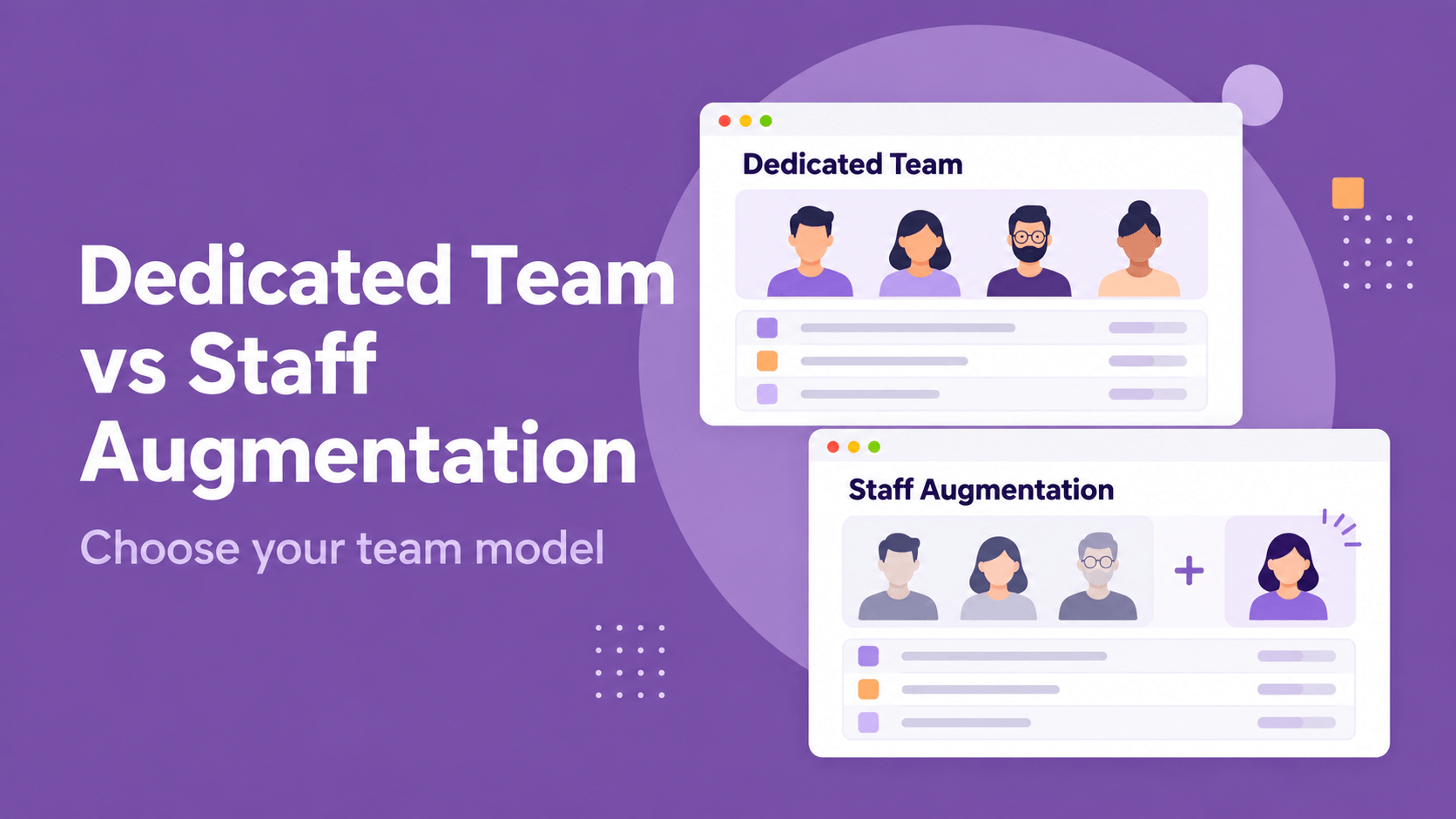
With staff augmentation, a partner provides pre-vetted engineers who join your existing team. They attend your standups, work in your repositories and tools, and take direction from your engineering manager or tech lead. You own the backlog, the architecture and the delivery plan; the partner handles sourcing, employment and replacement.
It works like an elastic extension of your own team. You can add a senior React engineer, a DevOps specialist or an AI/ML engineer for a defined period and scale back when the work is done.
Dedicated development team
A dedicated team is a complete, cross-functional unit, typically engineers, a designer, QA and a project or delivery manager, that owns a product or workstream end to end. You set goals and priorities; the team plans sprints, makes day-to-day technical decisions and is accountable for shipping.
The team is dedicated in the sense that it works only on your product over the long term, building up domain knowledge in the way an internal team would.
Dedicated development team vs staff augmentation compared
The table below compares the two models on the questions that matter most when you sign a contract.
| Factor | Staff augmentation | Dedicated development team |
|---|---|---|
| Who manages daily work | Your managers and tech leads | The partner’s delivery lead, aligned to your goals |
| Accountability | You own delivery; the partner owns talent quality | The team owns delivery against agreed outcomes |
| Composition | Individual roles chosen by you | Cross-functional team designed around the product |
| Your management overhead | Higher: onboarding, direction and reviews | Lower: you manage priorities, not people |
| Speed to start | Fast for a few roles | Fast, with a short team design phase |
| Best for | Skill gaps, capacity peaks, specialist expertise | New products, separate workstreams, teams without engineering leadership |
| Main risk | Stretching your leads too thin | Drifting from business context without regular product input |
When staff augmentation fits best
Staff augmentation works when you already have strong engineering leadership and a clear backlog, but not enough hands or not the right skills. Typical cases:
- A specific skill gap: you need an AI engineer, a mobile specialist or a DevOps engineer for six months but cannot justify a permanent hire.
- A capacity peak: a funding round, a major release or a migration temporarily doubles the work.
- Hiring lag: you have open roles that will take months to fill, and the roadmap cannot wait.
- Keeping architecture in-house: your tech leads want direct control over code, design decisions and standards.
The main condition is management capacity. Every augmented engineer needs onboarding, context and code reviews. If your leads are already stretched, adding people can slow the team down before it speeds up.
When a dedicated team fits best
A dedicated team is the better option when you need outcomes rather than individual contributors:
- A new product or major module that can be built with clear interfaces to the rest of your platform.
- No in-house engineering leadership, for example a non-technical founder or an operations-led SMB that needs a team to own engineering.
- A separate workstream, such as a mobile app, a data platform or a custom software replacement for tools you have outgrown, that should not distract your core team.
- Long-running roadmap delivery where continuity and domain knowledge compound over years.
The key success factor is product ownership on your side. A dedicated team still needs a product owner who sets priorities, joins sprint reviews and makes trade-off decisions quickly.
Need engineering capacity fast?
Tell us about your team gaps and timeline, and we will propose the right mix of augmented engineers or a dedicated team.
In-house hiring vs a development partner
Before choosing between the two partner models, it is worth asking whether you should use a partner at all. The honest answer depends on time horizon and how central the capability is to your business.
| Hire in-house when | Use a development partner when |
|---|---|
| The capability is core to your long-term advantage | You need to start delivering in weeks, not after a hiring cycle |
| The work is continuous and predictable for years | Demand is uncertain, seasonal or project-based |
| You can attract and retain the right people in your market | Specialist skills are scarce or only needed for a period |
| You have leadership to hire, manage and grow engineers | You lack engineering leadership or need an experienced team from day one |
| Deep institutional knowledge must stay inside the company | You want to validate a product before committing to permanent headcount |
These are not mutually exclusive. Many companies keep product ownership and architecture in-house, use a partner for delivery capacity and hire permanent staff as the product proves itself. If you are still sizing the investment, our guide to the cost to build a SaaS product shows how team model affects the budget.
Hybrid models and how teams evolve
Engagement models rarely stay fixed. A common pattern for growing companies looks like this:
- Start with a dedicated team to build the first version while you validate the market and hire key leaders.
- Hire a head of engineering or CTO, or use fractional CTO advisory, to own architecture and standards.
- Shift towards augmentation as your in-house team grows, keeping partner engineers for specialist or peak work.
- Consider an offshore development center when you want a stable, long-term team aligned to your time zone and ways of working, without building the entity yourself.
Whichever path you take, insist on documentation, shared repositories and regular knowledge transfer from the first sprint. It keeps your options open and prevents lock-in to any one team.
How to choose a partner for either model
Whichever way your dedicated development team vs staff augmentation decision goes, the partner’s quality decides the outcome. Check these points during selection:
- Seniority and vetting: how engineers are assessed, and whether you can interview them before they start.
- Onboarding speed: how quickly engineers become productive, and what the partner does to make that happen.
- Delivery practices: sprint cadence, code reviews, automated testing, CI/CD and how progress is reported. Teams that follow a recognized framework such as the Scrum Guide make ceremonies and roles predictable.
- Time-zone overlap: enough shared working hours for standups, reviews and quick decisions.
- Flexibility: how easily you can scale the team up or down, and what notice periods apply.
- IP and security: code ownership, NDAs, access controls and how credentials and data are handled.
- Continuity: how the partner handles replacements, holidays and attrition without disrupting delivery.
Pricing and contract considerations
Staff augmentation is usually billed per engineer per month or per hour, with rates varying by role and seniority. Dedicated teams are typically billed as a monthly team cost, sometimes with agreed deliverables or milestones. In both cases, compare the total cost of getting work done, including your own management time, rather than hourly rates alone.
Read the contract for notice periods, replacement guarantees, IP assignment, confidentiality and how scope changes are handled. A cheaper rate with long lock-in or unclear IP terms is rarely a good deal.
Frequently asked questions
What is the difference between staff augmentation and a dedicated team?
Staff augmentation adds individual engineers to your existing team under your management. A dedicated team is a cross-functional unit, managed by the partner, that takes ownership of delivering a product or workstream.
Is staff augmentation cheaper than a dedicated team?
Per person, the rates can be similar. Staff augmentation can cost less if you already have strong engineering management, but you carry the management overhead. A dedicated team includes delivery management, which often makes it more cost-effective when you lack that capacity.
When should a startup hire in-house developers instead of outsourcing?
Hire in-house when the work is core to your long-term advantage, continuous for years and you have the leadership to hire and grow engineers. Before that point, a partner often gets a product to market faster and with less fixed cost.
How quickly can an augmented engineer start?
With an established partner, pre-vetted engineers can often be embedded within days and become productive within the first week or two, depending on the complexity of your codebase and onboarding process.
Can I switch from staff augmentation to a dedicated team later?
Yes. Many companies move between models as their needs change. Make sure the contract allows flexible team sizing and that documentation and knowledge transfer are part of the engagement from the start.
Next steps
The right choice in the dedicated development team vs staff augmentation debate depends on who you want to own delivery and how much management capacity you have. To discuss your team gaps and delivery goals, get in touch with our team, or see how our Growth & Scale practice provides augmented engineers, dedicated teams and CTO advisory.