Legacy Application Modernization: 6 Approaches and How to Choose
Compare the six legacy application modernization approaches, from encapsulation to rebuild, and learn how the strangler fig pattern, careful data migration and a phased roadmap reduce risk.
⚡ Key takeaways
- Modernize for a business reason (cost, speed, risk or AI readiness), not because the technology is old.
- There are six main approaches, from encapsulating with APIs to a full rebuild; most programs combine several.
- The strangler fig pattern replaces a system piece by piece while the business keeps running.
- Data migration is usually the riskiest step: validate, reconcile and keep a rollback plan at every stage.
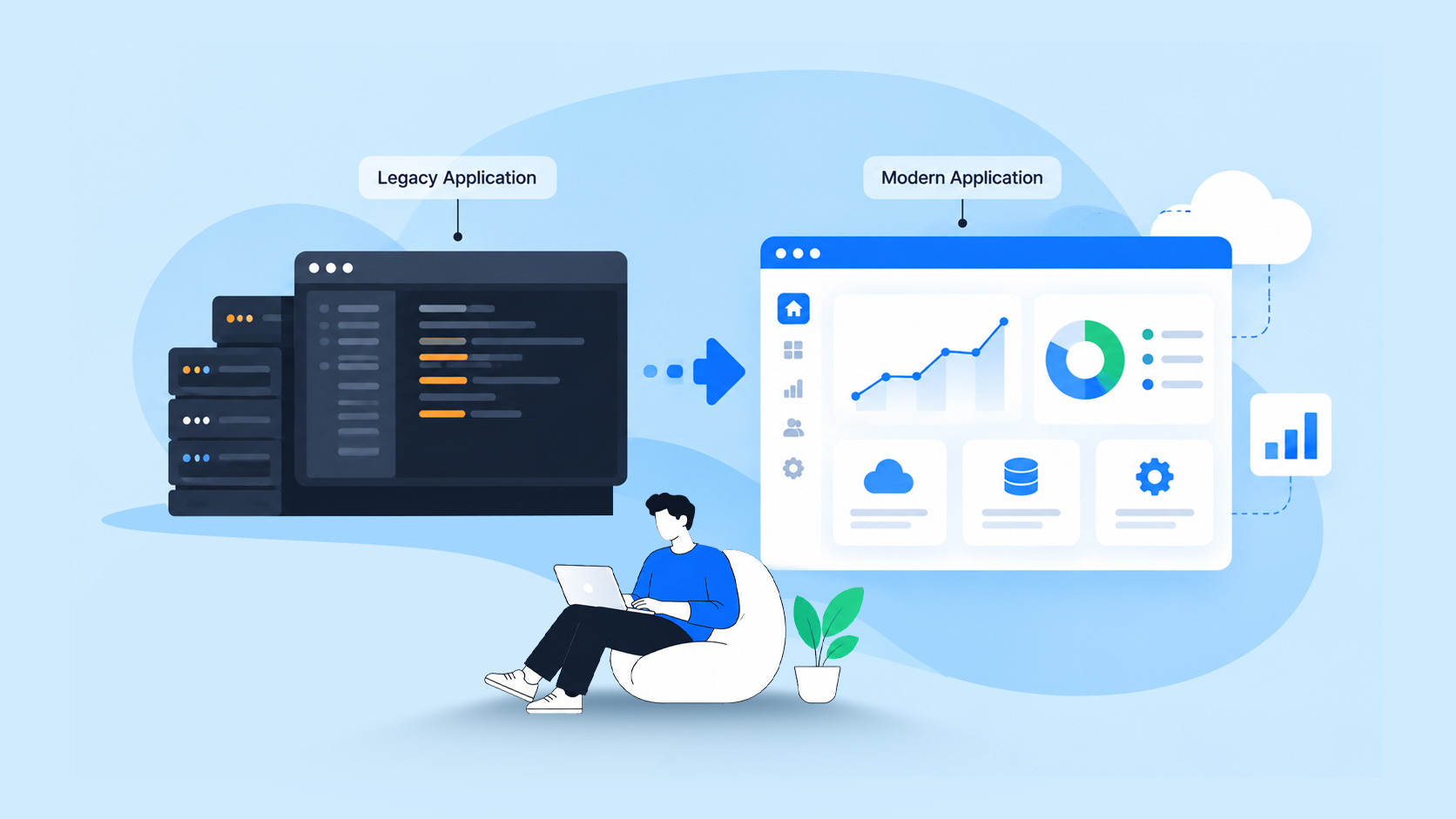
Legacy application modernization is the work of moving a business-critical system onto architecture, infrastructure and code that your team can change safely and quickly. The system may be ten or fifteen years old, hold years of business logic and data, and still run core operations. That value is exactly why a careless rewrite is so dangerous.
This guide explains the warning signs, the six common modernization approaches and when each fits, how the strangler fig pattern reduces risk, what to watch in data migration, and how to add AI to a legacy system incrementally. It ends with a comparison table and a step-by-step roadmap you can adapt.
Signs you need to modernize
Age alone is not a reason to modernize. A stable system that rarely changes may be fine as it is. The case becomes strong when the legacy platform starts limiting the business.
- Maintenance costs rise every year while feature delivery slows down.
- Engineers avoid touching it: few people understand the code, tests are thin and every release feels risky.
- End-of-life dependencies: unsupported frameworks, operating systems or databases that no longer receive security patches.
- No integration layer: partners, mobile apps or new frontends cannot connect without custom workarounds.
- Scaling limits: the system cannot handle peak load or new markets without expensive hardware.
- Data is locked in: you want analytics or AI, but the data has no API and no clean export path.
- Post-acquisition sprawl: you inherited a system you did not build and must integrate or retire it.
If three or more of these apply, it is worth running a structured assessment.
6 legacy application modernization approaches
The approaches below run from least to most invasive. They are not mutually exclusive: a typical program might encapsulate one module, rehost the rest, and rearchitect the part that changes most often.
1. Encapsulate
Wrap the legacy system in modern REST or GraphQL APIs without changing its internals. New frontends, mobile apps and third parties integrate through the API layer rather than touching legacy code.
When to use it: the core logic works, but you need integration quickly, or as a first step before deeper change.
2. Rehost
Move the application as-is to new infrastructure, usually from on-premise servers to cloud virtual machines. This is often called “lift and shift.”
When to use it: a data center exit or hardware refresh is forcing a move, and you need speed more than long-term optimization.
3. Replatform
Move to a modern platform with modest changes, for example containerizing the app with Docker, moving to a managed database, or upgrading an end-of-life runtime. The business logic stays largely the same.
When to use it: you want operational gains (scaling, patching, CI/CD) without the cost of reworking the code.
4. Refactor
Restructure and clean up existing code without changing its external behavior: reducing technical debt, adding tests, optimizing slow queries and removing dead code.
When to use it: the architecture is broadly sound, but code quality is slowing the team down.
5. Rearchitect
Change the architecture itself, typically breaking a monolith into modular services or microservices, introducing event-driven integration, or separating the frontend from the backend.
When to use it: the system needs to scale, deploy or evolve in ways the current structure cannot support, and the business logic is still worth keeping.
6. Rebuild or replace
Rewrite the application from scratch, or replace it with a SaaS or off-the-shelf product. This gives the cleanest result but carries the most delivery and business risk.
When to use it: the existing code cannot be salvaged, the business process has fundamentally changed, or a commodity product now does the job better.
Comparing the approaches
The table gives a qualitative view of cost, risk and time for each approach. Actual effort depends on the size of the system, the quality of documentation and tests, and the number of integrations.
| Approach | Cost | Risk | Time | Main benefit |
|---|---|---|---|---|
| Encapsulate | Low | Low | Low | Fast integration without touching legacy code |
| Rehost | Low | Low | Low | Exit on-premise hosting quickly |
| Replatform | Medium | Medium | Medium | Better operations, scaling and patching |
| Refactor | Medium | Medium | Medium | Lower technical debt, faster delivery |
| Rearchitect | High | Medium | High | Scalability and independent deployments |
| Rebuild / replace | High | High | High | Clean slate aligned to today’s needs |
Rearchitecting is marked medium risk rather than high because, done incrementally with the strangler fig pattern, it avoids a single big-bang cutover.
The strangler fig pattern
The strangler fig pattern, described by Martin Fowler in his original article, replaces a legacy system gradually. New functionality grows around the old system until the old one can be retired, much like the vine it is named after.
In practice it works like this:
- Put a routing layer, such as an API gateway or reverse proxy, in front of the legacy application.
- Pick one well-bounded capability, for example invoicing or user profiles, and build it as a new service.
- Route a small share of traffic to the new service using feature flags, and compare results with the legacy path.
- Increase traffic as confidence grows, then switch the capability over fully.
- Remove the retired code from the legacy system and repeat with the next capability.
The value of the strangler fig pattern is that every step is reversible: if a new component misbehaves, traffic goes back to the legacy path while you fix it.
The trade-off is that you run two systems in parallel for a while, which adds operational overhead and requires careful data synchronization. For most business-critical systems, that cost is worth the reduced risk.
Modernize without the rewrite risk
Tell us about your legacy system and your risk tolerance. We will design a phased approach that keeps the business running.
Data migration risks and how to manage them
Data is usually where legacy application modernization goes wrong. Old systems accumulate inconsistent formats, undocumented fields, duplicate records and business rules hidden in stored procedures or triggers.
Common risks
- Silent data loss from type mismatches, truncation or encoding differences.
- Broken business rules that lived in the database rather than the application code.
- Referential integrity issues when records move in stages.
- Downtime during large cutovers, and drift between systems during parallel running.
How to reduce them
- Profile the source data before designing the target schema.
- Automate migrations as repeatable scripts and rehearse them on production-like copies.
- Reconcile counts, totals and samples after every run.
- Use change data capture or dual writes to keep systems in sync during parallel running.
- Keep a documented, tested rollback plan at every stage.
Adding AI to legacy systems incrementally
You do not need to finish modernizing before you can use AI. An API layer around the legacy system is often enough to start retrofitting AI capabilities without rebuilding the core.
Good incremental starting points include:
- Intelligent search across records and documents using embeddings and semantic search.
- Automated summaries of case histories, tickets or long records.
- Natural-language interfaces that let staff query legacy data without complex screens.
- Workflow automation for classification, routing and data entry.
Most of these rely on retrieval-augmented generation (RAG), where the model answers from your own data. Our guide to a production-ready RAG system covers the retrieval, evaluation and guardrails involved. Start read-only, keep a human in the loop, and log every AI interaction for review. See OMANGOM’s AI services for how this fits a wider strategy.
A step-by-step legacy application modernization roadmap
A good roadmap delivers value at every phase rather than disappearing into a long, invisible rebuild. This sequence reflects how OMANGOM approaches Legacy Modernisation programs.
- Assess: audit architecture, dependencies, technical debt, data quality and business criticality of each component.
- Set goals: tie the program to measurable outcomes, such as release frequency, hosting cost, incident rate or new integrations.
- Choose an approach per component: use the comparison table to match each part of the system to an approach.
- Build the foundation: CI/CD pipelines, automated tests, observability and, where relevant, cloud infrastructure.
- Modernize incrementally: apply the strangler fig pattern, one capability at a time.
- Migrate data in stages: with reconciliation and rollback at every step.
- Run in parallel and validate: keep old and new side by side until the new path is proven.
- Decommission: retire legacy components and document the new system.
If the program includes moving off on-premise hosting, pair it with a clear cloud migration strategy and support from cloud and infrastructure specialists.
Frequently asked questions
What is legacy application modernization?
It is the process of updating an older, business-critical application so it is easier to change, integrate, scale and secure. It can range from wrapping the system in APIs to rearchitecting or fully replacing it.
How long does legacy modernization take?
It depends heavily on scope. Encapsulating or rehosting can be relatively quick, while incrementally rearchitecting a large monolith is typically a multi-month or multi-year program delivered in phases, with value released along the way.
Is it better to rewrite or refactor a legacy application?
Refactor or modernize incrementally when the business logic is still valuable and the code can be salvaged. Rewrite only when the code is beyond repair or the business process has changed fundamentally, and even then consider replacing it piece by piece.
Can you modernize a legacy system without downtime?
Yes, in most cases. Incremental approaches such as the strangler fig pattern, combined with parallel running and staged data migration, allow traffic to shift gradually with a rollback path at each step.
What is the difference between rehosting and replatforming?
Rehosting moves an application to new infrastructure without changing it. Replatforming makes targeted changes, such as containerizing or switching to a managed database, to benefit from the new platform.
Next steps
Every legacy system is different, so the right mix of approaches comes from a careful assessment. OMANGOM’s Legacy Modernisation team can audit your system and propose a phased roadmap. If you are also building new products on the modernized platform, our SaaS product development guide is a useful companion. Contact us to talk through your system, your drivers and your risk tolerance.